
AI Search & B2B: Why Social Media Is Invisible to LLMs
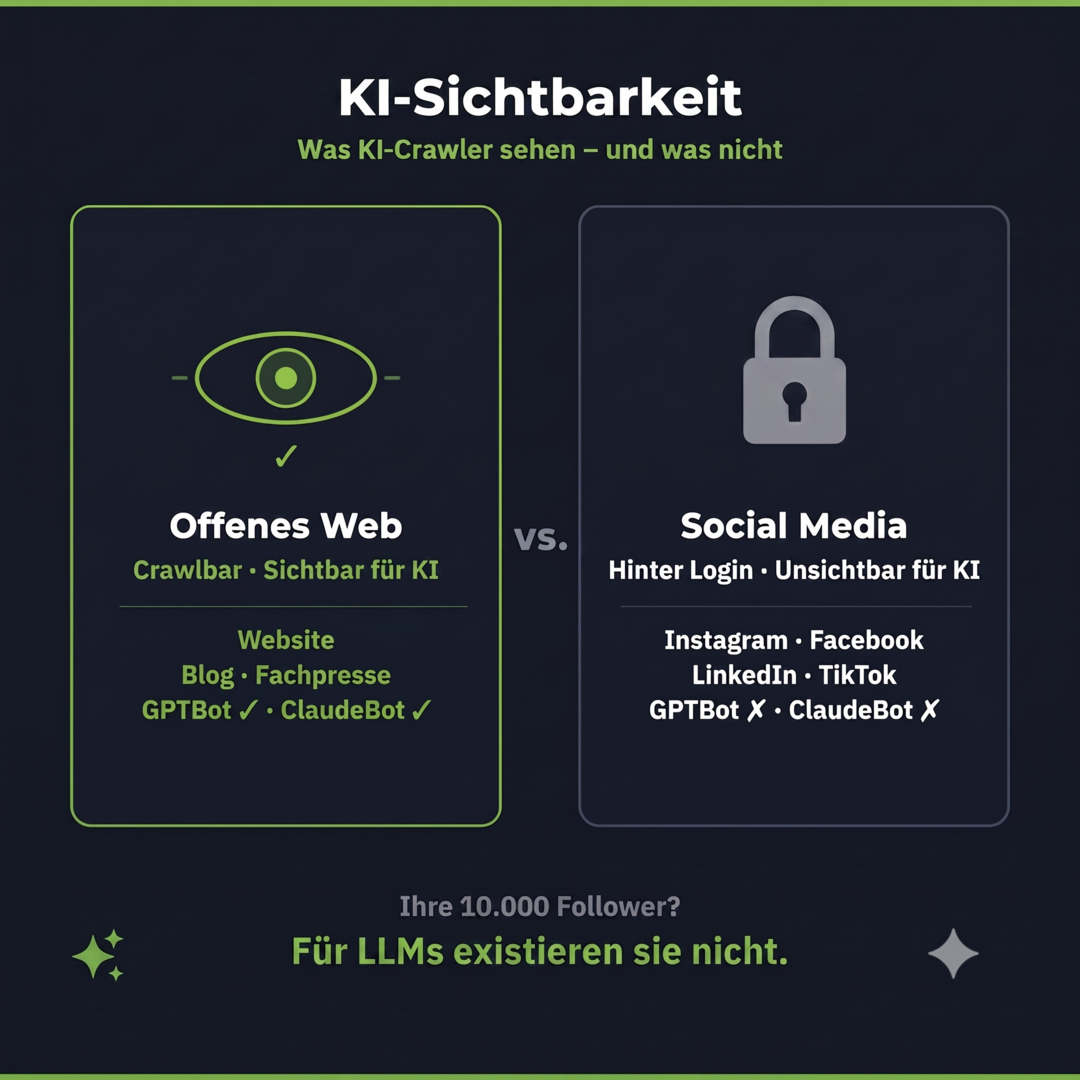
More and more buyers, engineers and decision-makers are using ChatGPT, Perplexity, Gemini or Claude for their research instead of traditional search engines. For companies, this raises a critical question: where do these systems actually get what they say about your products and technologies?
For many, the answer is sobering: large language models (LLMs) draw their knowledge overwhelmingly from the open web - crawlable websites, trade portals and press releases. Anything behind a login wall remains invisible to them.
Why AI systems barely see social media
Walled gardens: the blind spots of AI systems
For AI models to retrieve content at the moment of a query through live research (retrieval-augmented generation, or RAG), that content has to be freely accessible. This is exactly where most social media platforms fall short.
- In the West: Facebook groups, Instagram profiles and private LinkedIn feeds sit behind a login. LinkedIn also allows crawling only for selected search engines. Years of social media effort therefore contribute little to your direct visibility in Western AI answers.
- The special case of China: The digital ecosystem is built almost entirely on closed app infrastructures. Content from WeChat flows primarily into Tencent's own models (Hunyuan/Yuanbao), while other providers such as ByteDance with Doubao or DeepSeek are left out. The platforms shield themselves from one another. Anyone who wants to be found via AI in China therefore needs a presence in several app ecosystems at once.
The technical difference in source links (citations)
Modern AI search systems embed direct links to their sources (citations) in their answers. How these work depends fundamentally on the market:
- West (web-based): A click leads to a regular website. Here, the goal of GEO (generative engine optimization) is website traffic. Important: if your website relies heavily on pure client-side rendering (e.g. React, Vue), it remains invisible to many AI crawlers. Server-side rendered HTML content is a must.
- China (app-based): Links lead via deep linking directly into the respective mobile super apps. As platforms increasingly block AI-driven access from outside, what matters most is that content exists natively within each ecosystem - not just as an external link.
What this means for global B2B companies
As your target audience increasingly uses AI to research suppliers, the logic behind your content investments shifts:
- In the West, it's "website first": Your own website is the foundation of your AI visibility. Structured, in-depth and cleanly crawlable content determines whether AI cites you as a source.
- In China, it's platform-specific seeding: Content has to be fed directly into the ecosystems the leading models prefer - such as WeChat Official Accounts for Tencent or the ByteDance network for Doubao.
- Third-party sources as global amplifiers: Independent trade portals and industry media provide AI systems worldwide with evidence of your expertise.
Social media does not lose its value for human reach and brand building. In the West, however, it now plays an almost exclusively indirect role in your visibility in AI answers.
Measure instead of guess: the GEO approach with aiva
The crucial question is: how visible is your company really in global AI systems today - and how often are you cited?
This is where generative engine optimization (GEO) comes in. With aiva, we analyse your performance in the globally relevant systems based on data - from ChatGPT and Perplexity in the West to DeepSeek, Doubao or Ernie in China. We determine your Share of Model and Citation Frequency and show you the content gaps compared with your international competitors.
Would you like to know how visible your company is in AI answers worldwide? An aiva analysis gives you the answer in precise figures.
➡️ Download the sample aiva analysis (PDF)
➡️ Learn more about aiva
Questions about aiva or interested in your own analysis?
➡️ Request a quote