
TYPO3 Goes Agent-Ready: llms.txt in Two Commands
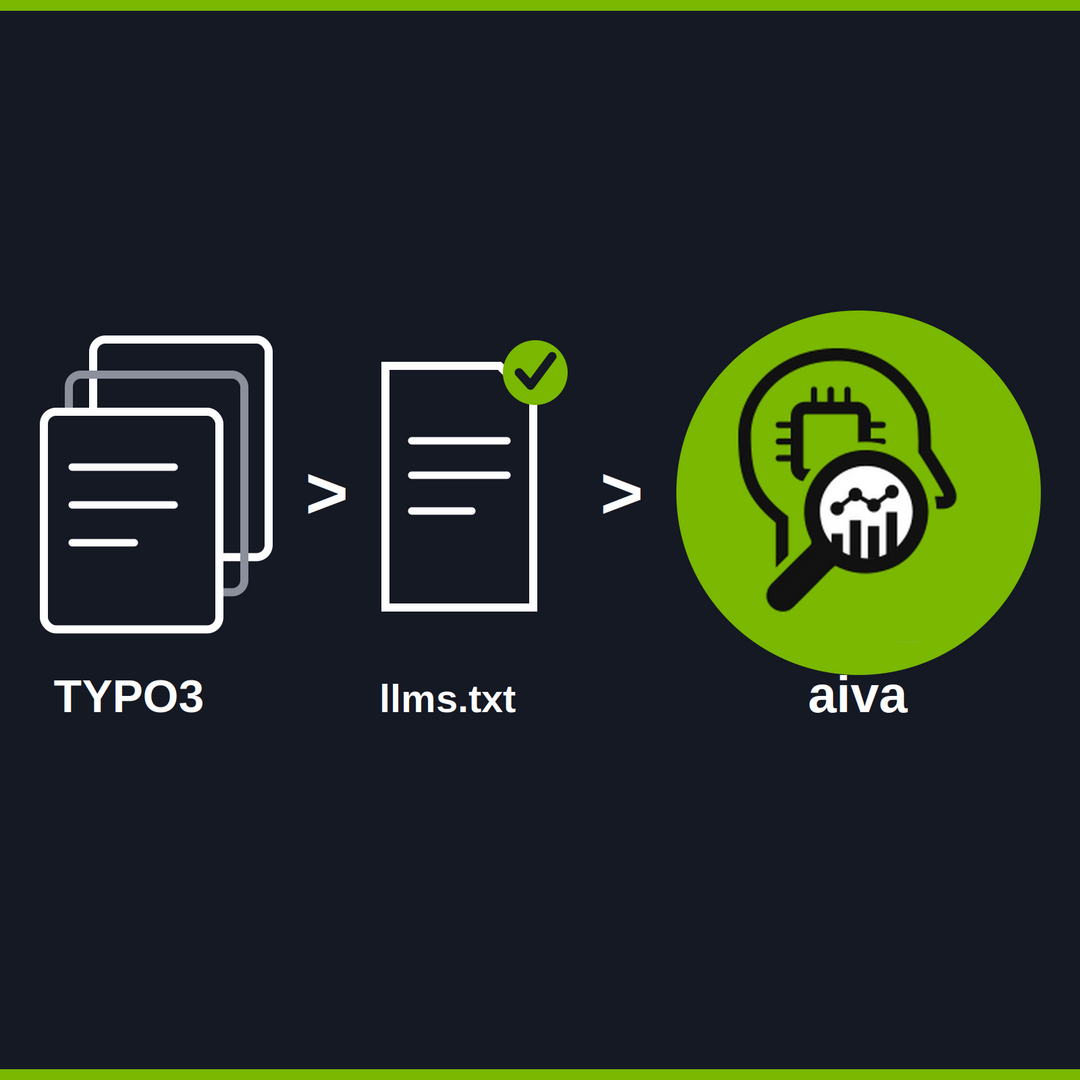
Anyone measuring their own AI visibility with aiva will almost always find a technical block among the recommendations: make content machine-readable, build clean structures, make it easier for AI crawlers to access. The strategic logic behind this is clear - AI systems and their agents can only process what they can technically read cleanly.
The practical question is: how do you implement that in your own CMS?
For many industrial companies in the DACH region, that CMS is TYPO3. The good news: the TYPO3 ecosystem has caught up quickly. What recently still required TypoScript tinkering can now be implemented in a few steps using ready-made extensions.
Why Machine-Readability Determines Visibility
LLMs and AI agents draw their knowledge from the open web - but not the way humans read websites. Navigation bars, layout nesting and scripts are dead weight to them, diluting the actual information. The llms.txt standard (llmstxt.org) addresses exactly that: a machine-readable overview file that explains a website's structure to AI systems, plus clean Markdown versions of the content. Offering both significantly lowers the barrier for AI crawlers - and increases the chance of being correctly understood and cited.
llms.txt in TYPO3: One Extension, Two Commands
For TYPO3, the extension rt_llms_txt (rtfirst/llms-txt) offers a mature, standard solution, documented at docs.typo3.org. It fully automatically generates a /llms.txt based on the page tree - a navigation hub for AI systems, including SEO metadata. Its most elegant feature is the .md suffix: any regular page can be called with the .md extension (e.g. your-domain.com/products.md) and then returns plain Markdown with YAML frontmatter instead of the HTML template - title, description, language, last-updated date. Navigation and layout elements are automatically stripped out.
The editorial control is noteworthy: the extension adds its own LLM tab to the page properties. Editors decide there, per page, whether it's released for AI crawlers, and can add dedicated AI summaries and topic tags. Optionally, an API key protects the endpoints so that only verified agents get access. Installation follows the modern Site Set concept: composer require rtfirst/llms-txt, then vendor/bin/typo3 extension:setup, activate the set in the site configuration - done.
For Context
No major AI provider has officially committed to supporting the standard yet, and server log analyses show that crawlers such as GPTBot or ClaudeBot currently fetch the file only rarely. That doesn't change the underlying logic: clean structure, Markdown versions and crawler-accessible rendering pay off regardless of whether llms.txt becomes an established standard - the implementation costs little and never hurts.
The Obligation Behind It: Content Structure
Technology alone isn't enough. For the automatic Markdown conversion to produce clean text, content maintenance needs discipline: separate content elements per section and subheading instead of large blocks of running text. The converter reads from the core database fields - the more cleanly the content is structured there, the more readable the result is for AI. This matches what we regularly see in aiva analyses: what gets cited is precise, clearly structured content, not nested layout constructs.
A Step Further: AI in the TYPO3 Backend
Anyone who wants to embed AI processes internally, not just become readable externally, will find nr-llm by Netresearch a shared AI foundation for TYPO3: a central connector for LLM providers ranging from OpenAI to Claude and Gemini, all the way to local models via Ollama. Building on that, things like image descriptions and metadata can be generated automatically - which in turn improves the quality of machine-readable content.
And How Do You Know It's Working? Measure It.
As low as the technical barrier now is - implementation is only the middle step in the cycle. It starts with measurement: an aiva analysis, using over 1,000 curated probe questions per industry, persona and language, shows how visible you are today, which sources feed the AI answers, and where competitors hold positions. From that come the prioritized recommendations - such as the technical optimization described here. And after implementation, a re-measurement shows whether share of model and citation frequency actually increase. Measure, identify, act, re-measure: only the closed loop turns an extension installation into a provable visibility strategy.
Conclusion
TYPO3 is well equipped for the age of AI agents: with rt_llms_txt, a website becomes agent-ready with minimal effort - provided the content structure is clean. Whether the effort pays off isn't a matter of belief. It's measurable.
From Implementation to Proof
The extension delivers the technology, but setup, clean content structure and the editorial LLM release per page need to be implemented properly. As a TYPO3 agency, we install and configure rt_llms_txt for you - including content cleanup, so the Markdown conversion actually produces clean text. And with aiva, we then deliver the proof: whether your AI visibility actually improves as a result.
Want to make your TYPO3 website agent-ready and measure the impact?
Get in touch