
Why Knowledge Hubs Matter in B2B
Why knowledge hubs are becoming more important in B2B
Context: LLMs and the shift in information-seeking behaviour
A few months later, in 2023, competition began among the language models that dominate the market today, and in 2024 artificial intelligence started to occupy almost every corner of our digital environment: in search engines, email clients, messengers and the everyday tools on our smartphones.
However, artificial intelligence has not only integrated itself into our interactive and informational systems, but also into our daily habits. According to the Reuters Institute (Simon et al., 2025), a study across six countries found that in 2025 the share of people who had ever used a generative AI system rose from 40% to 61% within a single year, and weekly use almost doubled from 18% to 34%. Information seeking also became the most important use case for these tools: weekly use for this purpose rose from 11% to 24%, overtaking content creation.
The arrival of LLMs in our digital environment has not completely replaced traditional search engines, but it has changed the way users search for and select information. This is particularly relevant in B2B.
According to Ahrefs (Stox, 2026), around 65% of ChatGPT usage consists of queries that would previously have been entered into a search engine; this corresponds to roughly 8.33 Google searches per query of this kind in ChatGPT. In other words, ChatGPT already handles around 12% of Google's search volume. Google usage has not declined to the same extent, however (total search volume across search engines and LLMs has grown); what has changed is the role each tool plays.
A Semrush survey of more than 500 B2B professionals in the US (Loktionova, 2026) showed that 66% regularly use AI to research products, vendors and solutions, with a further 29% doing so occasionally. As mentioned, however, AI has not replaced search engines: 75% still use Google or other search engines when researching vendors. What has changed is the order: 41% start with AI and then check the results in a search engine, while only 35% start with a search engine and use AI to summarise or compare. Gartner (2026) observes the same pattern from a sales perspective, as we will see later. But why does this matter in the context of knowledge hubs?
The same Semrush survey (Loktionova, 2026) shows that buyers do not consider a vendor simply because an LLM mentions it. What determines whether a brand is considered is whether the LLM's answer fits the specific use case. Interestingly, the brand mention is not the end of the process: when AI names a vendor, 71% visit its website and 63% google it. So it is not enough for a company's website to be mentioned in the answer or cited among the sources. What matters is that the answer can be verified on the cited website, and that the website addresses the need that triggered the search.
The trust paradox: AI as a source of information, but not a source of truth
B2B buyers obtain information from an LLM, but do not immediately accept it as absolute truth. This dual behaviour – using the model while also distrusting it – explains why a knowledge hub has become strategic, especially in B2B.
According to a Gartner survey published in May 2026 (Gartner, 2026), 69% of B2B buyers prefer to validate AI-generated insights with a sales representative. At the same time, 70% say they prefer a self-service experience. TrustRadius (2026) confirms the pattern from the perspective of technology buyers: in its January 2026 survey (1,862 buyers and 444 vendors), 63% had used AI during the buying process, but 94% of them verify its answers at least sometimes. To do so, they turn first to search engines (19%), then to the sources cited by the AI itself (11%), and finally to official or trusted sources (7%) (TrustRadius, n.d.). It is therefore essential that buyers have access to the detailed information they need to move through their customer journey – from evaluating products and offers to making a purchase. And this is exactly where knowledge hubs become relevant.
What is a knowledge hub?
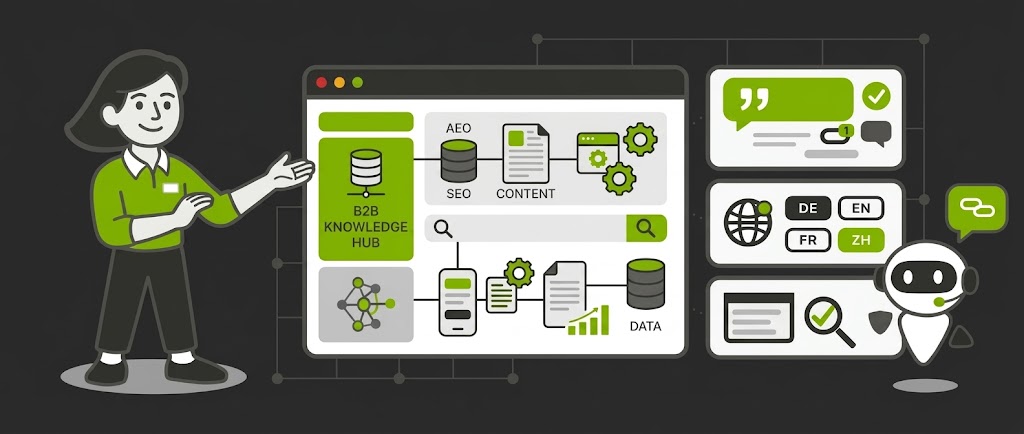
Knowledge hubs are the content pillars of a website whose main purpose is to answer the target audience's questions about the product rather than to sell it. They bring together, within a common architecture, the resources a buyer consults to understand a topic, evaluate a solution or clarify a specific question. Examples of knowledge hubs include:
- FAQs: direct answers to questions, phrased the way users would ask them.
- Glossary: definitions of the key terms for the industry, the products and the company itself – like our own glossary.
- Technical guides: how a product works, what its features are and what sets it apart.
- Product comparisons and use cases: verifiable content that helps users determine whether the product is right for their specific application.
What defines a knowledge hub is not the format, but the content itself: hubs are always organised and categorised by topic, and each main topic can have further "satellite pages" that explore or complement it. Unlike a blog article or a press release, this content is not replaced but updated as needed. A hub also differs from product or application pages, because its purpose is precisely to back up the content of those pages with facts and information.
But why do LLMs cite knowledge hubs?
A language model cites a page for several reasons: because it was able to find it, and because it judged its content to be useful for answering the user's question and aligned with its intent. And yes, knowledge hubs are structurally built for exactly that. To understand why this works, you need to know what it means when a website is cited by an LLM: a citation shows that the AI trusts the website as a source of knowledge – enough to send the user there (AirOps, n.d.). Which types of content AI systems tend to cite in practice is also covered in our article What Content AI Systems Actually Cite.
An LLM goes through a total of five steps to answer a query (AirOps, n.d.); three of them are decisive in this context:
- Interpretation: the model interprets the question and decides whether it can answer it with the data it was trained on or whether it needs to run a targeted web search.
- Retrieval: in this step, the language model retrieves candidate pages whose content it considers relevant to the question, either from its index or from a live web search.
- Evaluation and selection: in this step, the pages are ranked by relevance, source authority and structural clarity.
Each format of the hub plays a role at a different point in this sequence:
- The glossary, for example, answers definitional intent ("What is XY?") with a short, self-contained passage – the most easily extractable format there is.
- FAQs mirror the form of the question and therefore match the interpretation of the query in the first step.
- Technical guides, use cases and product comparisons provide the depth and authority that count in the third step, when the model has to evaluate and select the information on which it then bases its answer.
Why should knowledge hubs be best practice in B2B?
In B2B, a purchase is not a single decision but involves various stakeholders, whose questions usually differ considerably in each process; research cycles are also long and draw on a wide variety of information sources. This is how Semrush explains it in its guide to answer engine optimization for B2B (Lindley, 2026).
Multiple stakeholders, different questions: Semrush (Lindley, 2026) identifies up to six profiles in a typical buying center, for example: the technical evaluator asks about integrations, requirements and implementation; the security and compliance reviewer about certifications and data handling; the financial decision-maker about price, total cost of ownership and return on investment, and so on. Each profile can therefore be expected to receive a different AI answer. By strategically integrating a knowledge hub (especially with good information architecture across the website), every question any of these stakeholders might ask can be answered.
Long cycles: According to the 6sense report (2025, cited in Lindley, 2026), B2B buyers spend an average of 10.1 months on a purchase, with the shortlist forming very early in the research process. If the decision takes months and citations are drawn anew with every query, what matters is not appearing once, but being present consistently and with accurate information throughout the entire cycle. That requires durable, always up-to-date content – and a knowledge hub is the ideal content type for exactly that.
The knowledge hub as a place of verification
AI presents the user with the "research report", but the knowledge hub confirms that it is accurate. If 94% of buyers verify the answer they receive from AI (TrustRadius, 2026): what will they find on the website when they want to confirm that information?
First, they look for consistency. If the cited page confirms the statement in detail, trust in the vendor grows. If the page does not exist, is outdated or does not provide complete data, buyers do not conclude that the AI was wrong, but that the vendor is unreliable or not relevant to their request. A hub is the means of ensuring that the model's answer and the reality of the website match and meet the user's expectations.
Whether AI systems already cite your content as a source today – and which pages your competitors occupy instead – is shown by an aiva analysis.
Gartner (2026) also notes that buyers are comfortable informing themselves independently. A knowledge hub can simplify this process because it has the potential to provide all the documentation they need: use cases by industry, technical requirements, technical explanations, honest comparisons.
In summary: a citation in an LLM influences which B2B manufacturer makes the shortlist, but the content of the hub decides whether it stays there.
Would you like to know whether your content is cited in AI answers – and what a knowledge hub could look like for your company?
➡️ Download the sample aiva analysis (PDF)
➡️ Content for decision-makers and AI systems
➡️ Learn more about AEO & GEO
Questions about knowledge hubs or interested in your own analysis?
➡️ Request a quote
References
- AirOps. (n.d.). LLM citations. In AirOps glossary. Retrieved October 8, 2026, from www.airops.com/glossary/llm-citations
- Gartner. (2026, May 20). Gartner survey finds 69% of B2B buyers turn to sales reps to validate AI-generated insights [Press release]. www.gartner.com/en/newsroom/press-releases/2026-05-20-gartner-survey-finds-sixty-nine-percent-of-b-two-b-buyers-turn-to-sales-reps-to-validate-ai-generated-insights
- Lindley, A. (2026, September 25). B2B answer engine optimization: How to show up in AI. Semrush Blog. www.semrush.com/blog/b2b-answer-engine-optimization/
- Loktionova, M. (2026, July 8). How AI tools shape the B2B buying process: A survey of 600+ US business professionals. Semrush Blog. www.semrush.com/blog/how-ai-shapes-b2b-buying/
- Simon, F., Nielsen, R. K. & Fletcher, R. (2025). Generative AI and news report 2025: How people think about AI's role in journalism and society. Reuters Institute for the Study of Journalism, University of Oxford. reutersinstitute.politics.ox.ac.uk/generative-ai-and-news-report-2025-how-people-think-about-ais-role-journalism-and-society
- Stox, P. (2026, February 11). ChatGPT has 12% of Google's search volume but Google sends 190x more traffic to websites. Ahrefs Blog. ahrefs.com/blog/chatgpt-has-12-percent-of-googles-search-volume/
- TrustRadius. (2026, July 15). TrustRadius 2026 B2B Buying Disconnect Report reveals AI has changed how buyers research, but not what they trust [Press release]. HG Insights. hginsights.com/news/trustradius-2026-b2b-buying-disconnect-report-reveals-ai-has-changed-how-buyers-research-but-not-what-they-trust/
- TrustRadius. (n.d.). Beyond the hype: The AI bubble that isn't bursting (yet). TrustRadius Buyer Blog. Retrieved October 8, 2026, from solutions.trustradius.com/buyer-blog/beyond-the-hype